Impact of COVID-19 on International Tourist Arrivals in Nepal (2015–2024)
The travel industry has rarely suffered such a blow as it did with the COVID-19 pandemic. W ith the virus outbreak in the early part of 2020, nearly all countries closed their doors to the world, stopped international flights, and imposed hard lockdowns. Due to these measures, people lost the ability to travel at their will. Hence, worldwide tourism shrank by over 70%, the hospitality sector and airlines went into deep financial red, and the workforce of the tourism sector, in millions, was turned into layoffs. The destinations that once attracted most travelers, such as Europe, America, and Southeast Asia, witnessed the massive decline of their visitors and then their economies.
COVID-19 hit Nepal really hard, even double compared to many other countries. Over the years, tourism has been one of the major industries in Nepal that has sustained thousands of families guides, porters, hotel owners, travel companies, airlines, and local markets. After the borders were closed and international flights stopped, the number of tourists visiting Nepal dropped from over 1.19 million in 2019 to just 230,000 in 2020, and even fewer in 2021. There were no crowds on popular trekking trails of Mount Everest Base Camp, Annapurna, and Langtang. Climbers canceled mountaineering expeditions, and many guesthouses and restaurants closed up. Because Nepal is very reliant on foreign tourists for income, the economic loss was much more severe and difficult than other countries. The tourism sector in Nepal was still struggling when the rest of the world was slowly getting back to normal, due to limited flights, the slow reopening, and strict safety regulations.
Nepal is situated between two countries India and China . Although it is Sandwich between international powers, conflicts have not happened between any , and peace remains. Nepal is a country of various castes and cultures. In other words, it is like a beautiful garden of flowers with people of different ethnicity and backgrounds .
Nepal is not only unique for its flag but also its geographical terrain, the variety of castes and cultures you can find , and the rich history of it . It is the land of various great places and important figures that people know far and wide . The temperature here spans from cool to hot and is a heaven for residing it .
Our country is very rich in its geographical terrain. From the lowest point of just 70 meters from sea level to the world’s highest peak Mt. Everest ( 8848.86 meters) , we have temperature scales that very from place to place . It is divided into three regions, Terai, Hilly , and Himalayas each according to their altitude and geographical difference.
Out of the world’s top 10 highest peaks, 8 of them fall in Nepal . It is already a great pride to have come from such a country. The diverse flora and fauna, beautiful landscapes and green jungles, historical and religious places in Nepal are enough to gather the attention of foreigners and locals too . People from all over the world pay thousands of dollars just to see our country’s mountains, rivers, waterfall, the rich flora and fauna , and sites of great religious and his historical importance. Gautam Buddha is also a founder of Buddhism which is practiced worldwide was also born in Nepal . Buddhism is known to peace and non- violence and we love everyone.
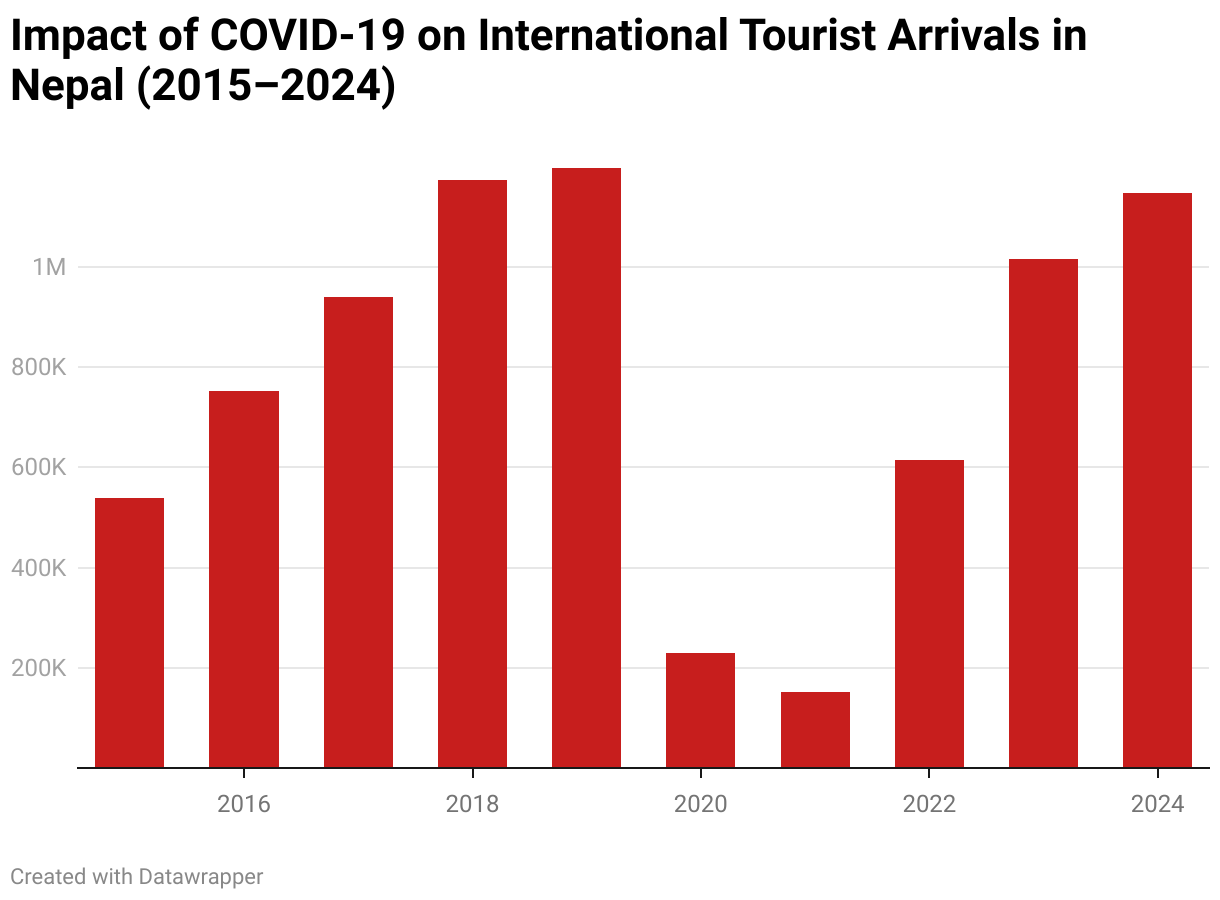
What caused the differences in speed of recovery: The speed at which Nepal's tourism business got back on its feet after the pandemic was different in various areas and was influenced by numerous factors interconnected. Visitors started flowing from countries that reopened earlier, especially India, which is the largest and nearest market of Nepal, and this is what gave the recovery a shove. Slowly, as the international airlines restored their routes and added more seats, more travelers got to come back. At the same time, the tourists' view of safety, travel advisories, and even the occasional political uncertainty affected the groups which decided to come to Nepal. Therefore, these factors had a different impact on the revival of the arrival rate from the different markets. In order to make the tourism sector less vulnerable to shocks in the future, Nepal requires long-term strategies which not only focus on the structural aspects but also the operational ones. By taking the promotion outside the few traditional markets, the country can lessen the risk of being affected by a global crisis. Hence, apart from having health and safety standards that are clear and better air connectivity, Nepal can attract more tourists through the creation of new tourism products-fresh need for eco-tourism, communities-based experiences, or even visiting during the off-season. On the other hand, strengthening digital systems, workforce training, and provision of financial support during the crisis will be a source of businesses' and employees' resilience when the industry is hit with an unforeseen shock.

Saru Bhujel

Comments
Post a Comment